How to practice speaking Spanish with no one around
No partner, no class nearby? Five out-loud drills you can do alone, what each one can't catch, and a 4-week plan to hear your own progress.
By Mathias C.
Learn with a private tutor, 50% offon Preply, with our link →
To practice speaking in Spanish with no one around, talk out loud for 15 minutes a day: narrate what you're doing, answer a question against a timer, repeat native audio, and record yourself once a week. If you study on your own, live far from Spanish speakers or feel too shy to call anyone yet, this gets your mouth working before you need it.
Most guides stop at a list of drills. This one says which part of speaking each drill trains, what it can't catch, and when to add a real person.
Why is practicing Spanish speaking alone harder than it looks?
Solo practice only covers half of speaking. The Council of Europe's CEFR splits speaking into two activities: spoken production, where you talk in a long turn (describe, explain, tell a story), and spoken interaction, where you also have to understand the other person and react. Talking to yourself trains the first one well and the second one barely.
That explains a common experience. You can describe your apartment fluently in the shower, then freeze when a waiter asks "¿Para llevar o para tomar aquí?" (to go or to eat here?). Nothing was wrong with your drills. They just never forced you to decode a question you didn't write. The second gap is feedback: if you say "estoy embarazada" (I'm pregnant) when you mean "me da vergüenza" (I'm embarrassed), no recording will flag it unless you already know the word.
Which Spanish speaking practice methods work best alone?
The best solo Spanish speaking practice methods are the ones where you choose the words yourself: narration and timed answers. Shadowing fixes pronunciation, recordings show you where you hesitate, and an AI voice assistant is the only solo option that answers back. Here is what each one trains and who catches your mistakes.
| Method | Minutes a day | CEFR skill it trains | Who catches your mistakes |
|---|---|---|---|
| Narrating what you do | 5 | Production | Nobody, unless you record it |
| Timed 60-second answers | 5 | Production | You, on the recording |
| Shadowing native audio | 5 | Pronunciation, rhythm | You, by comparing with the audio |
| Weekly recording | 5 once a week | Production | You, a week later |
| AI voice conversation | 10 | Production, some interaction | The AI, if you ask it to |
| Language exchange or tutor | 25 to 50 | Production and interaction | A person |
Verdict: narration and timed answers do most of the work alone, but only the last two rows put someone in front of you who can reply.
A few details make these drills stick:
- Narrate in the present first ("Ahora estoy preparando el café"), then retell the same moment in the past that evening ("Esta mañana preparé el café").
- For timed answers, pick one question a day, such as "¿Qué hiciste el fin de semana?", set a 60-second timer and don't stop. If a word is missing, go around it.
- Shadow 30 seconds of a podcast at a time, repeating a split second behind the speaker, three times in a row.
- Keep the weekly recording on the same question, so the only thing that changes is you.
How do you practice speaking Spanish with an AI voice assistant?
Practicing Spanish with an AI voice assistant works like a conversation you can pause: you talk, it answers and asks a follow-up. Open the voice mode of an assistant such as ChatGPT, ask it to speak only Spanish at your level, and ask for corrections after each of your answers.
I do this in English, not Spanish: every morning in traffic, I talk out loud with ChatGPT's voice mode about my day and my plans. It won't replace my 50-minute lessons, but it means I arrive at them already warmed up. A Spanish version of the opening prompt could be: "Habla conmigo en español sobre mi día. Nivel A2. Corrígeme después de cada respuesta."
Two limits. The assistant is polite by default and lets small errors go unless you insist on corrections. And it doesn't know your real week, so it can't role-play your next client call or your landlord unless you describe them first.
What does four weeks of Spanish speaking practice look like?
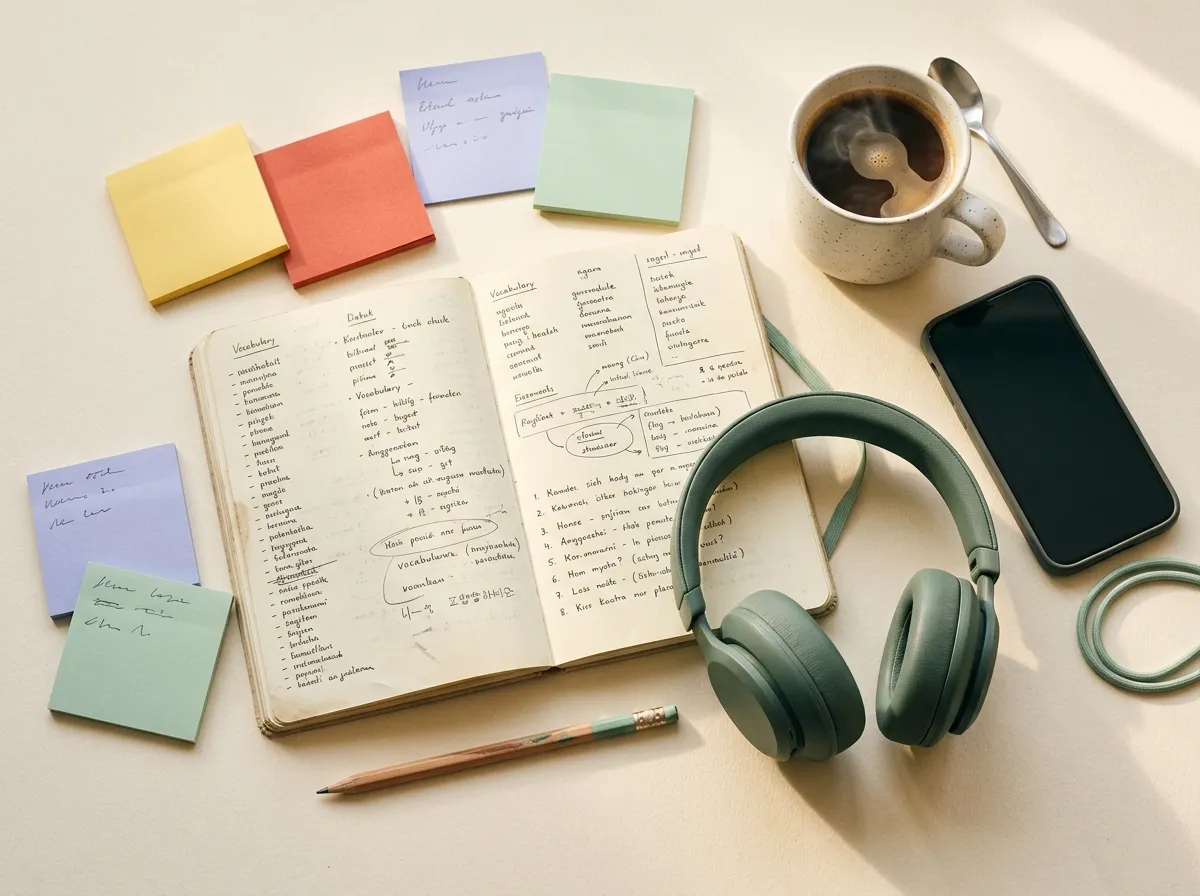
Four weeks of Spanish speaking practice at 15 minutes a day is enough to hear a difference on your own recordings. The plan below uses the drills from the table and ends each week with the same one-minute recording.
- Week 1: narrate in the present tense for 5 minutes a day. On day 7, record your answer to "Describe tu día normal" for 60 seconds.
- Week 2: add timed answers with a new question each day. Retell your day in the past every evening.
- Week 3: add 5 minutes of shadowing and one 10-minute AI conversation twice a week, with corrections switched on.
- Week 4: record the week 1 question again and play both files back to back. Count the pauses longer than two seconds and the English words that slipped in.
If the second recording has fewer pauses, the routine works. If it doesn't, you're probably reading notes or thinking in English first: close the notes and describe smaller things.
When should you practice speaking Spanish with a real person?
Practice speaking Spanish with a real person as soon as you can talk for a minute without stopping. After that point, solo drills give less and less back, because the missing skill is interaction: understanding a reply at native speed and answering on the spot.
A language exchange app such as Tandem or HelloTalk is the free route, though half of each session goes to your partner's English, and partners cancel. A local conversation table costs nothing if there's one near you. A tutor costs money but spends the whole lesson on your Spanish.
On Preply, a trial lesson lasts 25 or 50 minutes, and each account can get up to 2 free trial replacements if the tutor isn't a fit (Preply Help Center, checked September 2026). The downside is the price: I pay about €34 an hour for my English lessons, so a weekly lesson is a real budget line. Our guide to finding an online Spanish tutor compares rates by platform, and the Preply review lists what we don't like.
Skip paid lessons if you haven't yet kept up the 15-minute daily drills for two weeks: the habit matters more than the tutor. If you're preparing a trip, our page for people learning before they travel has phrase guides, and if you work full time, see how to fit Spanish around a job. Every other Spanish guide is on the Spanish learning hub.
Not sure which level to give the AI or the tutor? The level quiz tells you in two minutes.
Questions people ask about practicing Spanish speaking alone
Can you learn to speak Spanish by talking to yourself?
You can get faster and more confident at building sentences by talking to yourself, and that is real progress. You won't learn to follow a fast reply or handle an interruption, because you control both sides. Use self-talk to prepare, then test it with a person.
How many minutes a day should I practice speaking Spanish?
Fifteen to twenty minutes out loud every day works better than one long session a week. Split it: five minutes of narration, five of timed answers, five of shadowing. Record one answer a week so you can compare.
Is shadowing good for Spanish speaking?
Shadowing is good for pronunciation and rhythm: you repeat native audio a split second behind the speaker. It doesn't train you to build your own sentences, so pair it with narration or timed answers where you choose the words.
Can ChatGPT help me practice speaking Spanish?
Yes. ChatGPT's voice mode can hold a spoken conversation in Spanish and answer follow-up questions. Ask it to correct you after each answer, otherwise it tends to let mistakes pass. It is a useful rehearsal partner, not a replacement for a person who knows your goals.
How do I practice speaking Spanish if I'm shy?
Start alone: record a one-minute answer, listen once, record it again. After two or three weeks, try a text-and-voice-note exchange before a live call. When you book a tutor, say in the first minute that speaking makes you nervous, so they slow down.