Spanish flashcards for beginners: the first 200 cards
Making a first deck for your kid or yourself? Here is what to put on 200 cards, how many to add a day, and when to put the deck down and speak.
By Mathias C.
Learn with a private tutor, 50% offon Preply, with our link →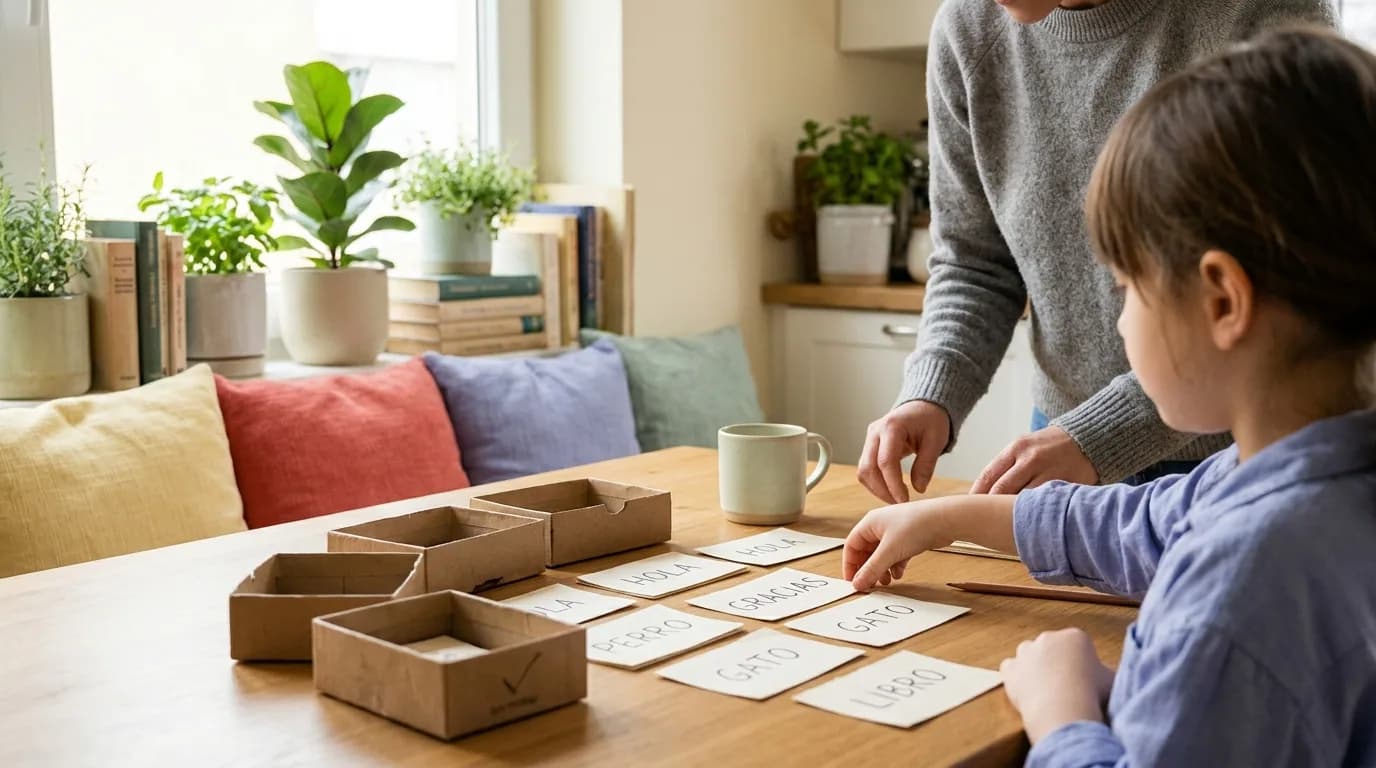
Spanish flashcards for beginners work best when the first 200 cards follow word frequency, not a theme like "fruit" or "animals". If you're a parent making a first deck for your kid, or an adult starting from zero, this guide gives you the split by card type, example cards you can copy, a daily pace, and the point where cards stop helping.
A flashcard here means any card with a prompt on one side and the answer on the other, on paper or in an app. The method behind it is retrieval: you try to recall the answer before you look.
Which words should go on your first Spanish flashcards?
The first Spanish flashcards should hold the most frequent words, because a small set of words makes up most of what people say. In Mark Davies's 2005 corpus study for the Routledge frequency dictionary, the 1,000 most frequent Spanish words (lemmas, so tener counts once for tengo, tienes and tuvo) covered most of each text type.
| Words learned | Spoken Spanish | Fiction | Non-fiction |
|---|---|---|---|
| First 1,000 | 87.8% | 79.6% | 76.0% |
| Next 1,000 | +4.9% | +6.5% | +8.0% |
| Next 1,000 | +2.3% | +3.5% | +4.2% |
| Total, first 3,000 | 94.0% | 89.6% | 88.2% |
Source: Davies (2005), Table 3, share of all words in each type of text.
Verdict: the first thousand words do far more work than the next two thousand combined, and they matter most for speech. The top 1,000 words covered 87.8% of spoken Spanish in that corpus. Davies turned this data into A Frequency Dictionary of Spanish; the second edition (Routledge, 2018) is built from a corpus of more than 2 billion words from 21 Spanish-speaking countries.
Two cautions. Coverage is not comprehension: knowing 88% of the words in a sentence still leaves gaps. And the most frequent words are small ones like de, que and en, which make poor cards on their own. That shapes the deck below.
How should you split 200 beginner Spanish flashcards?
A 200-card beginner Spanish deck should mix card types: whole phrases you can use on day one, the most common verbs, everyday nouns with their article, and sentence cards that carry the small words. The split below adds up to 200 and puts speaking first.
| Card type | Cards | Front (English) | Back (Spanish) |
|---|---|---|---|
| Survival phrases | 40 | I don't understand. | No entiendo. |
| Survival phrases | Can you repeat, please? | ¿Puede repetir, por favor? (formal) | |
| Common verbs (infinitive + "I" form) | 30 | to have / I have | tener / tengo |
| Common verbs | to want / I want | querer / quiero | |
| Nouns with article | 50 | the house | la casa |
| Nouns with article | the day | el día | |
| Small words in a sentence | 30 | The book is for you. | El libro es para ti. |
| Adjectives | 20 | big / small | grande / pequeño |
| Numbers 0 to 20 | 20 | fifteen | quince |
| Question words | 10 | Where? | ¿Dónde? |
Verdict: 40 phrases and 30 verbs give you something to say in the first week, while the nouns fill in what you talk about. For the question words, our Spanish question words practice has the accent rules and 18 sentences to drill.
Pick the nouns and verbs from a frequency list rather than a theme book. Verbs like ser, estar, tener, hacer, ir, poder and querer show up in almost every conversation, so they belong in the first 30.
What should go on each side of a Spanish flashcard?
A good Spanish flashcard tests one thing: one word or one short phrase, with English on the front and Spanish on the back. The Anki manual gives the same advice in its own words: split content into separate pieces so each one can be tested on its own (Anki manual, checked November 2026).
On the Spanish side, add the details that beginners get wrong:
- the article with every noun (el día, la mano), since gender is hard to guess
- every accent and the opening ¿ or ¡
- formal or informal, when the phrase changes (¿Puedes…? to a friend, ¿Puede…? to a stranger)
- the "I" form of each verb, because tengo looks nothing like tener
- a recording or a pronunciation note, if your app or your kid's teacher can provide one
English to Spanish is the harder direction, and the useful one for speaking. Spanish to English is enough for reading. For verbs and phrases, make both.
How many new Spanish flashcards should a beginner add each day?
Ten new Spanish flashcards a day is a pace most beginners can keep. The Anki manual says that if you consistently learn 20 new cards a day, you can expect roughly 200 reviews a day. Reviews pile up because every card keeps coming back at longer intervals, so the daily load grows for weeks before it levels off.
At 10 new cards a day, the 200-card deck is fully introduced in 20 days. If the reviews start taking more than 15 minutes, stop adding new cards for a few days; the manual itself recommends introducing fewer new cards until the review burden goes down. Anki's default target, its desired retention, is 90%: the app schedules each card so you have a 90% chance of remembering it when it comes up.
For a child, cut the pace further. Five new picture cards a day, reviewed as a game, is plenty.
Printable Spanish flashcards or an app: which works for kids and adults?
Printable Spanish flashcards and apps work the same way, as long as you test yourself and see hard cards more often. Testing is the part that matters. In a 2008 study by Karpicke and Roediger, published in Science, students who kept testing themselves on Swahili word pairs recalled about 80% a week later; those who dropped words from testing once they knew them recalled 33% to 36% (Purdue University News).
Choose by who uses the deck:
- Young kids: printed picture cards, played as a matching or "show me" game, five minutes a day. Our list of language apps for kids covers the screen options if you want one.
- Teens and adults with a phone: a spaced repetition app. The Anki desktop app, the AnkiWeb sync service and AnkiDroid on Android are free; AnkiMobile on iPhone is paid (Anki official site, checked November 2026).
- People who learn by writing: paper cards in three boxes. Box one daily, box two every few days, box three weekly; any card you miss goes back to box one.
Make your own cards where you can. The Anki manual says entering the information yourself forces you to decide what the key points are. Shared decks save time but come with someone else's word choices.
Why won't Spanish flashcards alone teach a beginner to speak?
Spanish flashcards teach you to recall single words, while speaking means building sentences fast and understanding the reply. A deck of 200 cards cannot train either, because no card answers back. That gap is why many learners who know hundreds of words still freeze in their first real conversation.
I'm learning English, not Spanish, with a tutor on Preply, and my passive level was already good before I started. What changed things was speaking for most of every 50-minute lesson. Cards won't do that for you. Once the first 100 cards are solid, use them out loud: describe your day with the verbs, ask the question words, and get corrected. Our guide to practicing Spanish speaking has drills that use exactly this kind of vocabulary.
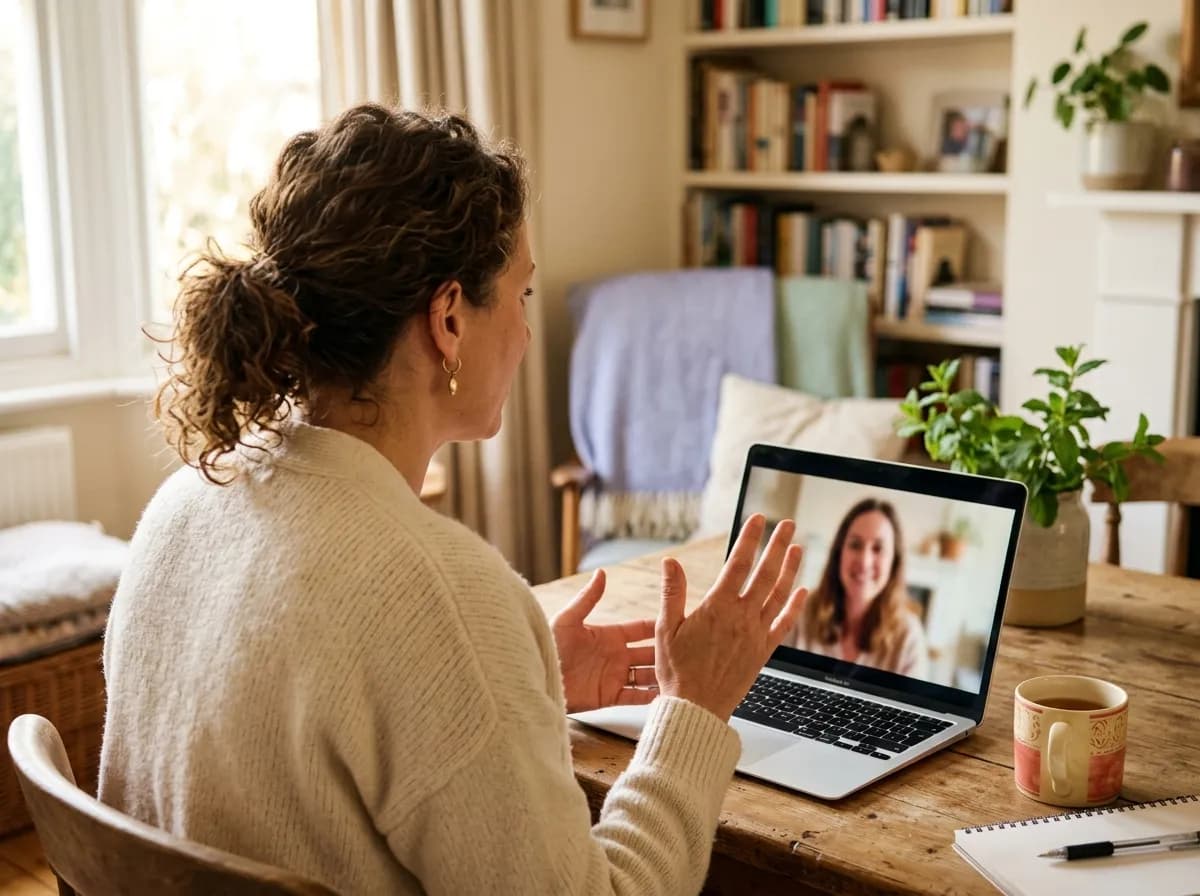
For a child, a tutor who teaches kids can turn the deck into a game of questions and answers in Spanish. Skip paid lessons in the first two or three weeks if the cards alone keep your kid busy and curious; book a trial once the words are there and nobody at home can reply in Spanish. More ideas for parents are on our page for parents raising a Spanish speaker, and the Spanish guides cover grammar for the next step.
Questions beginners ask about Spanish flashcards
How many Spanish flashcards should a beginner learn a day?
Ten new cards a day is a sustainable start. The Anki manual says 20 new cards a day leads to about 200 reviews a day once the deck builds up, which is too much for most beginners and for any child. At 10 a day, a 200-card deck is fully introduced in 20 days.
Should the front of a Spanish flashcard be in English or Spanish?
Use both directions for the most useful words. Spanish to English trains recognition, which is enough for reading. English to Spanish forces you to produce the word, which is what you need to speak. If you only have time for one direction, pick English to Spanish for verbs and survival phrases.
Are printable Spanish flashcards as good as an app like Anki?
Paper cards work if you sort them into boxes by how well you know them, so hard cards come back more often. An app does that sorting for you. For young children, paper is often better because you can play with the cards. For adults with a phone, a free app saves time.
How many Spanish words do you need for basic conversation?
No official count exists for basic conversation. What the research gives is coverage: in Mark Davies's 2005 corpus study, the 1,000 most frequent Spanish words covered 87.8% of the words in spoken Spanish. That makes the first 1,000 words a good long-term target, and the first 200 a useful start.
Do flashcards help kids learn Spanish?
Flashcards help kids remember words, especially picture cards played as a game for a few minutes. They do not teach a child to understand a conversation or answer back. Pair the cards with listening and with short spoken exchanges, at home or with a tutor who teaches children.
- Mark Davies (2005), Vocabulary range and text coverage: insights from the forthcoming Routledge Frequency Dictionary of Spanish
- Routledge: A Frequency Dictionary of Spanish, 2nd edition (2018)
- Anki manual: deck options (new cards per day, review load, desired retention), checked November 2026
- Anki official site: free desktop app, AnkiWeb and AnkiDroid, checked November 2026
- Purdue University News (2008): retrieval practice study by Karpicke and Roediger, Science